


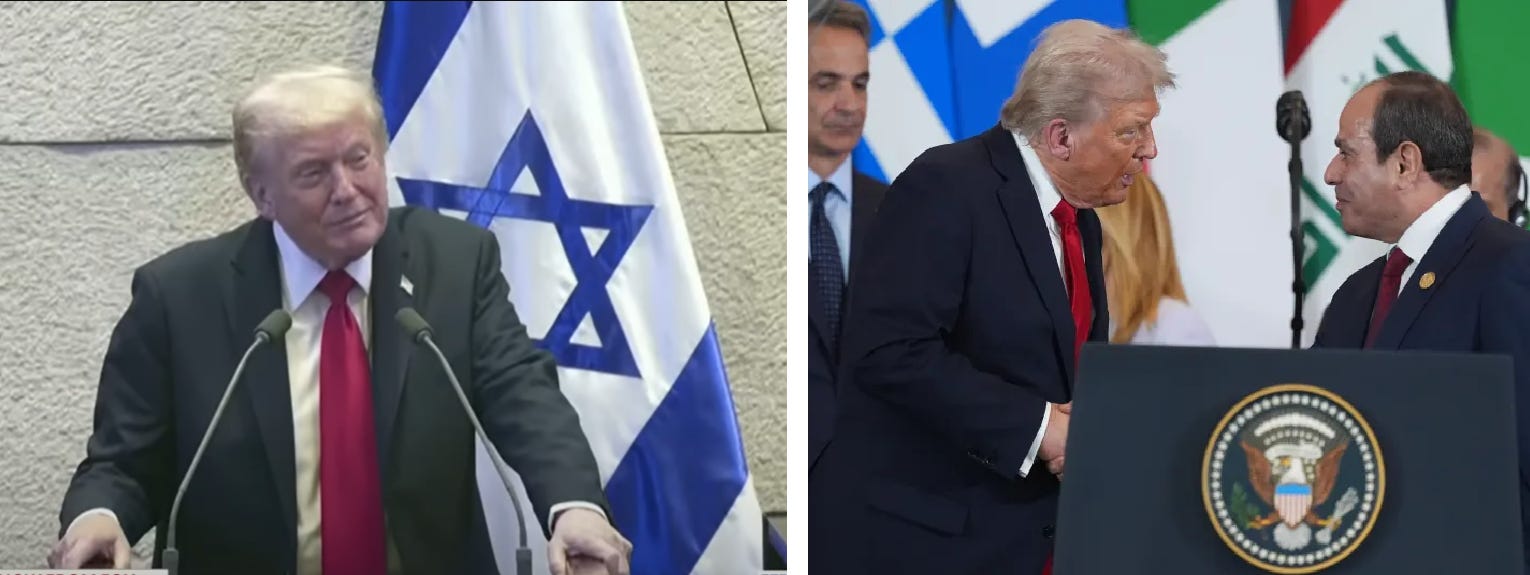
President Donald Trump traveled to Israel and Egypt to finalize the ceasefire agreement and oversee the signing of the Gaza Peace Agreement in Sharm el-Sheikh.
In Jerusalem, he addressed the Knesset alongside Prime Minister Benjamin Netanyahu and opposition leader Yair Lapid, outlining the terms of the ceasefire, the release of hostages, and the framework for Gaza’s reconstruction.
In Egypt, he co-chaired the Middle East Peace Summit with President Abdel Fattah al-Sisi, where he joined the leaders of Türkiye and Qatar in signing the agreement. The summit gathered over 30 heads of state and representatives from Europe and the Middle East.
This digest summarizes the key elements of the visit and the dynamics shaping the agreement. The full analysis below explores how each actor—Washington, Cairo, Tel Aviv, and European capitals—interprets this new phase in the region’s balance of power.
The Optics of Triumph, the Substance of Leverage
In Jerusalem, President Trump framed the ceasefire as a product of strength. He credited joint U.S.–Israeli operations against Iran for making peace possible and presented the outcome as proof of restored American leadership. His remarks on the Abraham Accords emphasized continuity but also revealed their limits: regional participation now reflects strategic dependence more than enthusiasm.
Trump thanked Arab states for backing Gaza’s reconstruction and pressuring Hamas to accept the deal, positioning Washington as the central broker while minimizing local agency. Netanyahu, meanwhile, avoided firm commitments, offering symbolic gratitude and steering clear of implementation details to preserve political agility at home.
Egypt’s Quiet Victory and the Gulf’s Visible Absence
At the Sharm el-Sheikh Summit, Egypt re-emerged as the region’s central broker. Co-chairing with President Trump restored Cairo’s leadership role and underscored Washington’s coordination with Egypt to stabilize Gaza.
Saudi Arabia and the UAE, by contrast, took a step back. Their leaders stayed home, unwilling to play a supporting role to Cairo. Egypt reclaimed political weight, with the Gulf expected to finance reconstruction, while the United States managed both.
Israel’s Political Fragility and the Price of Pardon
Trump’s call in the Knesset for Israel’s president to pardon Prime Minister Netanyahu was a deliberate signal, not a slip of diplomacy. It acknowledged how domestic politics had prolonged the conflict and underscored Washington’s role in pushing for the ceasefire.
Netanyahu avoided specifics in his own remarks, focusing instead on gratitude and symbolism to preserve his coalition’s support. His position remains constrained by the same internal pressures that fueled the war in the first place.
Europe’s Re-Entry and the Multipolar Shadow
European leaders used the Sharm el-Sheikh Summit to signal that the continent is not content to remain a bystander in Middle East diplomacy. France, the UK, and Germany joined the process as both partners to Washington and quiet competitors, seeking to reassert Europe’s political and economic influence in the region.
Their recognition of Palestinian statehood and plans to co-host Gaza’s reconstruction conference reveal a push toward greater strategic autonomy. For Trump, their participation validated his peace drive — but also diluted Washington’s exclusive hold on the narrative.
Fragile Frameworks: Why This Peace May Not Hold
The Gaza peace deal rests on tactical alignments, not durable commitments. Netanyahu accepted it under U.S. pressure and domestic political incentives, but his coalition’s hardliners are likely to resist deeper implementation once the immediate gains fade.
Hamas agreed under regional pressure from Egypt, Qatar, and Türkiye, yet none of those guarantors can enforce compliance if the process unravels. The absence of accountability mechanisms leaves grievances unresolved, creating conditions for renewed radicalization.
__
A detailed in-depth report on the implementation phase of the Gaza Peace Agreement will be released within the week.
Full Analysis:
Keep reading with a 7-day free trial
Subscribe to Thotharis to keep reading this post and get 7 days of free access to the full post archives.