

Representing a Government, Not Yourself: Lessons from Two Recent Diplomatic Controversies


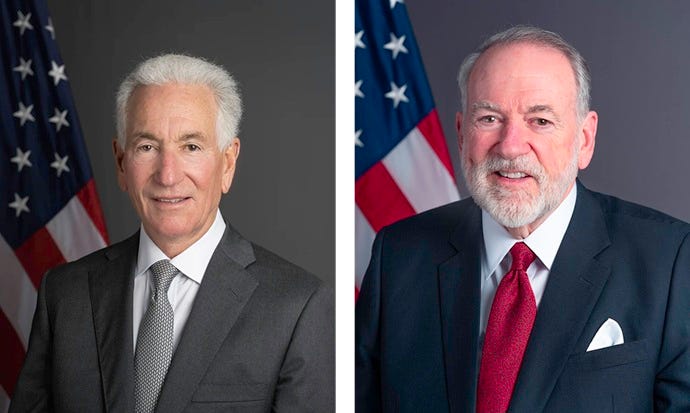
With the controversies surrounding the American ambassadors to Israel and France, I’ve received several questions about one of diplomacy’s oldest tensions: political appointees versus career diplomats, and whether the problems arising in these two cases reflect a fundamental flaw in political appointments or are simply isolated incidents.
The Two Tracks
Career diplomats rise through the ranks over decades, accumulating institutional knowledge, protocol fluency, and networks with their counterparts around the world.
Political appointees are selected directly by the head of government, with no formal requirements beyond that selection. They can come from any background.
The ratio varies widely across governments. Some rely heavily on political appointments, driven by proximity to the head of government. Others keep them to a minimum.
The Advantages of Political Appointees
A political appointee can have a more direct line to the head of government than any career diplomat, which translates to faster communication and greater clarity on intent. They tend to be less institutionally rigid, sometimes spotting opportunities their more protocol-bound counterparts would miss, and are granted more leeway on protocol by host governments, which creates room for maneuverability. They can at times operate simultaneously as official channels and backchannels, a genuinely valuable capability.
The Core Risk
The fundamental vulnerability is role confusion. Political appointees can forget that an ambassador represents a government, not themselves — and begin stating personal opinions or adopting individual postures rather than official positions in public engagements.
The line between individual and institution blurs, and that can cascade and compound into systemic friction with host governments, limiting both the ambassador’s and the embassy’s ability to engage effectively on its core functions.
When it Works, and When it Doesn’t
It works when the appointee leverages the professional diplomatic staff around them. The embassy’s career corps provides the institutional depth — protocol knowledge, relationship capital, situational awareness. The appointee provides the access, agility, and the direct line. Used well, that combination can be powerful.
It fails when the appointee ignores that staff, treating professional advice as an obstacle rather than an asset, resulting not only in internal friction but additional work to mitigate any damage rising from misunderstandings or poor positioning.
The current controversies around the American ambassadors to Israel and France illustrate this dynamic directly. Both were selected on the basis of personal trust, both carry significant influence within the domestic political ecosystem, and both are accustomed to operating in environments very different from the diplomatic one, and have brought those habits with them. The result, in each case, is a distinct failure mode worth examining separately.
Failure Mode One: Bilateral Breakdown (Kushner, France)
In France, Ambassador Kushner ignored a summons from the French ministry of foreign affairs for a meeting.
This is a diplomatic faux pas of the highest order; ignoring the main channel of communication of the host government is the highest form of snub an ambassador can do and is contrary to the core purpose of their role in their country of accreditation.
The response of the French government illustrates the seriousness of this decision; it has banned Ambassador Kushner from meeting with any French officials until he responds to this meeting. It means the ambassador has lost the ability to perform the embassy’s core function: being the communication bridge between two governments.
This failure mode is rooted in a conflation of personal positioning with the role as accredited ambassador. Kushner is a well-positioned, influential personality; he is the father of Jared Kushner, Trump’s son-in-law and special envoy.
To him personally, a summons from the French ministry of foreign affairs reads as inconsequential; he is after all higher positioned personally within the domestic political ecosystem than any ambassador would be.
However, that summons is not a personal request. It is directed to the title: Ambassador of the United States to France, not to Charles Kushner as an individual.
Role confusion is the key failure mode here: he responded personally to a message directed to his current position, not his person.
Failure mode two: Regional Cascade (Huckabee, Israel)
Ambassador Huckabee’s situation exhibits a different failure mode. The core issue in this case was his public statements during his interview with Tucker Carlson. In that interview, he made several statements that reflected his own personal views rather than the official position of the United States government.
Because he was speaking as an accredited ambassador, his statements were received and responded to by other governments as official positioning, and while they didn’t harm his standing in Israel, where he is accredited, they triggered official protests from a number of governments across the region.
The failure mode here is making public statements as an individual rather than a representative of the government that accredited him.
The Bottom Line
The success or failure of political ambassadorial appointees hinges on the balancing act between personal access and institutional depth; operating with increased agility to further the government’s positioning and interests is a success, causing excessive friction requiring damage control is not.
In both these cases the consequences will likely be minimal, if any at all. Diplomatic corps, particularly those with the depth of expertise in the American State Department, are adept at managing this sort of fallout.
The real problems arise when this becomes a recurring pattern; while individual incidents such as those mentioned above are recoverable (diplomatic corps are built to absorb them) accumulated damage is more problematic; at some point, the relationship becomes about managing the ambassador, which is when the liability outweighs the access.
Political appointments can work when managed and balanced, leveraging the advantages of access and institutional depth simultaneously, but can become a liability when the appointee’s personal identity overwhelms the institutional role they were sent to represent.
Huckabee is a strong Evangelical, which tells you everything you need to know. And he has the support of Trump...
"...Ambassador Huckabee’s situation exhibits a different failure mode. The core issue in this case was his public statements during his interview with Tucker Carlson. In that interview, he made several statements that reflected his own personal views rather than the official position of the United States government....!
This is pure thestre.
If you strip away the pretence, Mike Huckabee is in effect an employee of the same money machine that purchased and elected the man who appointed Huckabee. Furthermore, Huckabee has no real constituency other than this entity. Note that the adminstration, in all other arenas, has dispensed with formalities of office. A billioniare who pays enough money can show up as a government employee, download the data of all Americans and leave. A TV show lawyer can show up as Attorney General, and insult congressmen at congress.
All previous formalities of the old days are gone.
Huckabe made a public statement of what the adminstration has as its policy. That is how this works these days.
Much more interesting would be to dive into the fact that the US govt has publically announced that it will help Israel do a "Gaddafi" or an "Assad" on all the governments of the Arab countries that say they are US "allies". And that the "allies" are still pretending this isnt what was said.
Bear in mind also that the TRump I admin previously made a mockery of the two state solution that all the arab "allies" said they hold dear, by de facto recognising the israeli regime's illegal annexation of Jerusalem, whihc surely was a major embarassment to them, and laid bare they total vasssalhood they actually operate in.
There is a bizarre theatrical performance being enacted that appears to include suicide even. Why not talk about what is really going on instead of pretending that a well known court jester actually has any agency here, and inst part of a show he is forced to perform in?