


In the previous piece, we looked at the historical progression of Palestinian recognition, the reasons it lagged behind Israel’s recognition throughout the decades from the 1940s to 1988 when it declared independence, to the emergence of recognition as it fulfilled the requirements of statehood.
We saw how the recognition movement drew geopolitical line between the Global South and North, and how the fractures in these lines grew throughout the early 2000s to the mid 2010s as more Western states began to recognize the State of Palestine. We closed on the reasons recognitions slowed down between the 2010s and the 2020s, and why the new wave gained momentum during the current Israeli war on Gaza, and how geopolitical developments across the world including Trump’s return to office has impacted this pattern.
And this is where we will pick up, with the wave of recognitions of Palestine during the high level week of the 80th round of the UN General Assembly, and explore their impacts on the global power architecture.
The UN Arena
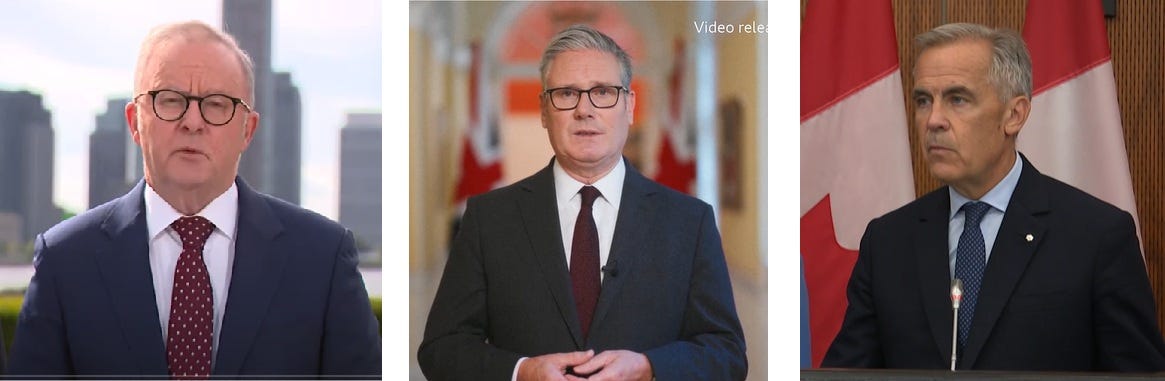
As of now, more than 150 countries recognize the state of Palestine, with the United Kingdom, Australia and Canada recognizing it hours ago. This forms a solid majority of the 193 members of the UN, standing at 77% of the membership of the organization. However, there are other important considerations beyond the broad membership of the General Assembly to account for.
While the UN General Assembly represents the full membership of the organization, the preeminent organ that determines full membership of the UN, and the organ that is at the beating heart of the organization remains the Security Council. This Council has a membership of 15 states, with 5 permanent members – the United States, China, Russia, the United Kingdom, and France. The permanent members have the veto power, which dictates that if any of them votes against any particular resolution, it is deemed failed even if every other member votes in favor.
Any state applying for membership must receive the recommendation of the Security Council, which must vote by at least 9 votes in favor and, crucially, have no opposing votes by any of the 5 permanent members.
This key organ, until yesterday, had a 3 to 2 recognition split, with the United States, the United Kingdom, and France not recognizing, and China and Russia in the recognition camp. As of tomorrow, the split will be 4 to 1 in favor of recognition.
While the United States retains the power to veto any progress on membership, as is its prerogative as a permanent member of the Council, the fact that it stands alone among the permanent members signals both its eroding influence and its loss of narrative control over the peace process in the Middle East.
It will likely be compelled to use its veto more often, singling itself out as an obstacle to progress on this matter, and playing a defensive game where it once dictated the course of events. It signals that even close allies are no longer bound to the logic of the 1993 Oslo agreements that preconditioned recognition on the final status agreements between Israel and Palestine, a framework that allowed Washington to set the pace.
It amplifies American isolation on the intergovernmental arena and will likely echo throughout other files of interest to the United States, files where it will be likely compelled to make concessions it otherwise would prefer not to in order to limit the pressures it faces on the Palestine recognition front.
It further breaks the former consensus among the old lines. In the Security Council permanent membership, the lines on Palestine were drawn between East and West, but as both European members recognize Palestine this week, the consensus shifts in favor of recognition, depriving the U.S. of the ability to speak on behalf of the collective West on the issue. This is a political loss for Washington, that had used this consensus to amplify its voice and gather support for its positions among the Security Council. With this shift, it can no longer count on its partners to automatically rally to its support.
Meanwhile, the additional recognitions will consolidate the pattern within the General Assembly. This organ, despite the non-binding nature of its resolutions, represents the tide of global opinion more democratically than the more exclusive Security Council. Already the pattern of overwhelming support for Palestine is strongly reflected within this Assembly, with the most recent vote last week seeing 142 votes in favor of the Two State Solution and only 10 votes against, 2 of which were the United States and Israel. More recognitions will gather more momentum, and more political pressure on Washington over time.
Beyond the UN: Mapping out Changes in International Organizations
The UN is but one of the theatres that will be affected by these potential recognitions. Beyond it, there are key global and regional blocs that will experience similar dynamic shifts to which they had previously been immune.
Chief among them is the G7. This bloc represents almost 30% of the global economy, and has historically been one of the bulwarks of American influence. It has been a stage through which members amplified their reach, influence, and coordinated much of their foreign policy.
This group, that includes the United States, Canada, Germany, Italy, Japan, France and the United Kingdom, was fully aligned on the issues of Israel-Palestine. None of its members, until today, recognized the state of Palestine. With the current recognitions however, the shift is both swift and dramatic: of the 7 members, 3 have announced their recognitions, marking a near 50% split in ranks.
This remarkable shift delineates a new dynamic within the group, one of reduced consensus, of increased member autonomy. With the recognitions, the group would no longer collectively be held to the Oslo framework of final status agreement before recognition, and rather than a pro Washington voice on the issue, could serve as a source of pressure on it when it comes to this topic.
The next key international organ to be affected is NATO. As of yesterday date, 14 of the 32 members of the bloc recognized Palestine. If all the announced recognitions move forward, between 4 and 5 more members could shift to the recognition camp (Belgium’s announcement regarding its recognition remains conditional). Already, the UK and Canada have announced their recognition.
That would mean that nearly 60% of NATO would recognize Palestine, signaling an important shift in approach to Middle East policy. Notably, it is not a simple matter of numbers; the announced recognitions all come from founding members of NATO, among them two of the three nuclear powers in NATO (France and the United Kingdom).
Another bloc that will experience a shift will be the European Union. The EU, unlike NATO and the G7 does not revolve around a central gravitational center. Where the United States wields direct disproportionate influence on the former two, there is no equivalent within the EU, with France and Germany standing out as the two most prominent members of the bloc.
Yesterday, 10 of the 27 members recognized Palestine, but with five potential recognitions on the line, (France, Malta, Portugal, Luxembourg, and Belgium) that number rises to 15. That is a near even split among the members, with the majority leaning in favor of recognition. The ensuing political dynamics within the EU will therefore likely shift toward alignment with this growing trend, splitting the bloc farther away from Washington’s policies on the region.
Already over the past weeks leading up to the rising recognition trend, the EU has been more vocal both in its criticisms of Israel’s excesses and transgression in Gaza and the West Bank, and its proposals for actions including economic sanctions, and sanctions on Israeli officials. This trend is likely to continue.
A less prominent but nevertheless still relevant change lies within the group of the Five Eyes, a specifically intelligence focused grouping of Anglosphere countries (the United States, the United Kingdom, Canada, Australia and New Zealand). Yesterday, this group had no recognitions but as of today, 3 of the 5 members recognize the State of Palestine, with a fourth (New Zealand) teetering on the edge of recognition.
Taken together, this is a significant if not monumental shift in the global narrative surrounding the Middle East. With these shifts in Western blocs that had previously held the American line, the majority of Global and regional blocs, both in the Global South and North, have now sidled away from the American led paradigm of final status negotiations before recognition.
It signals waning influence from Washington, disillusionment by allies, and a renewed approach to charting independent foreign policies in the Middle East and beyond.
Shifting Alignments
The issue of Israel and Palestine has historically been dealt with along North-South or East-West lines. Whenever proposed changes in the dynamic were proposed in intergovernmental bodies, the collective West could be counted on to stall it under the Oslo paradigm (final status agreements first, recognition second). With this shift in the recognition map, this dynamic will likely see changes.
As it stands, as of this week, the chief opposition camp against recognition revolves around the United States, Israel, and Germany. Those are the three main countries who have either structural (United States) or doctrinal (Germany) or both (Israel) opposition to recognition.
The remaining holdouts in Europe are largely influenced by their security and defense reliance on both Washington and Berlin. They are the countries most exposed to the Russian threat from the east, and in need of sustained political support from Washington to deter Moscow. This means that any wavering from the United States (such as the recently proposed suspension of support to the Baltic states) when it comes to their security and/or defense might see a recalculation of their own positions on the issue to align with broader European consensus.
In East Asia a similar pattern arises, Japan and South Korea consider the United States as their primary security guarantor against a potentially aggressive China. Their primary concern therefore remains to ensure the continuity of these guarantees, and they are unlikely to sacrifice them in service to a political stance on an issue half a world away and that does not have direct impact on their domestic political situation.
However, due to the conditional nature of this alignment, and the lack of doctrinal correlation, a thawing in relations with China, or a perceived faltering of American security guarantees could precipitate changes in positions.
The remainder of non-recognizing states, follow similar lines. They are largely comprised of countries that are bound to American foreign policy as a result of tightly woven interests with Washington, and remain unaffected by the Middle East peace process as result of geographic or political distance that reduces internal political pressure on governments.
Notably, with the exception of Germany, none of the holdout camps are holding out because of any special relationship with Israel, but rather due to their alignment with American policy. This in itself is an important factor moving forward because if American relations with these countries were to change, or if the American position itself were to shift, they may veer toward recognition as well to align with growing international consensus.
The fault lines on Palestine no longer rest on the paradigm of West versus East or North versus South, but rather the United States, Israel and some American allies against a growing global consensus.
Immediate Responses
Already, Israel and the United States have begun responding to the growing consensus with scathing criticisms, and actions aimed at containing the momentum. Washington denied an entry visa to the Palestinian president, preventing him from delivering his statement at the UN General Assembly. This is the second time that the United States adopts this measure, the first being when Yasser Arafat, the chairman of the PLO at the time, declared independence for Palestine in 1988.
When the United States took this decision in 1988, the General Assembly moved its session to Geneva, which was a scathing rebuke by the international community. This time around, they simply skirted the measure by adopting a decision allowing the Palestinian president to address the Assembly through video.
In both instances, the decision was rooted both in Washington’s incentive to retain control of the narrative and the White House’s incentive to placate the pro-Israel voices in congress. Internationally, the response to this decision is largely negative even among allies, but it is nothing Washington hasn’t weathered before, and domestically it was met by approval from its target audience.
The Israeli government has promised escalatory steps in response to the recognition, accusing the recognizing governments of rewarding Hamas, while proclaiming expansions in territorial seizures, annexations and expansions of settlements in the West Bank and redoubled operations in Gaza. This was met largely with dismissal, because Israel was already progressing with those plans on the ground; Netanyahu and his coalition partners had already stated on several occasions that they would prevent the establishment of a Palestinian state, and that they would expand annexation plans, even as they progressed with the displacement of Palestinians from Gaza.
While European governments proceed with recognition and reshape political dynamics on the international arena, Israel is adopting the facts on the ground approach; it is shifting the balance of power and the starting point of any future negotiations. By proceeding with its offensive in Gaza, its displacement of Palestinians, its splitting of the West Bank and its potential annexation, it is creating a de facto reality on the ground that will be difficult to reverse through simple diplomatic measures.
The race between the meeting rooms of the UN and the shifting state of affairs on the ground is now in full swing. With every recognition, Israel’s urgency increases and will likely continue to escalate the pace and intensity of its attacks and land seizures. Netanyahu’s legitimacy with his coalition now rests on his ability to fend off international pressure, to continue with expansion and displacement, and somehow regain control of the narrative.
Symbolism vs. Substance
Recognition of Palestine has now ventured well into the Western camp, previously adamantly opposed to recognition before settling on final status agreements between Israel and Palestine. The former standoff between the Global South and the Global North has been replaced by a political tableau that pits the United States and Israel against an expanding international consensus, while the latter accelerates its bid to cement facts on the ground.
Yet recognition, for all its weight in symbols and institutions, does not by itself automatically redraw realities in Gaza or the West Bank. It does not halt the advance of settlements, reverse territorial seizures, or shield civilians from bombardment. What it does is shift the diplomatic terrain—altering the legitimacy of claims, reframing alliances, and raising the political cost of denial—while the struggle on the ground continues to be dictated by force.
Recognition reshapes the stage but not the battlefield. The question is whether this widening circle of legitimacy translates into real leverage, which is what we will look at in the next part of this series: from the symbolism of recognition to its substance. Can the new map of recognition drive tangible shifts on the ground, or is it destined to remain confined to diplomatic gestures and meeting rooms?